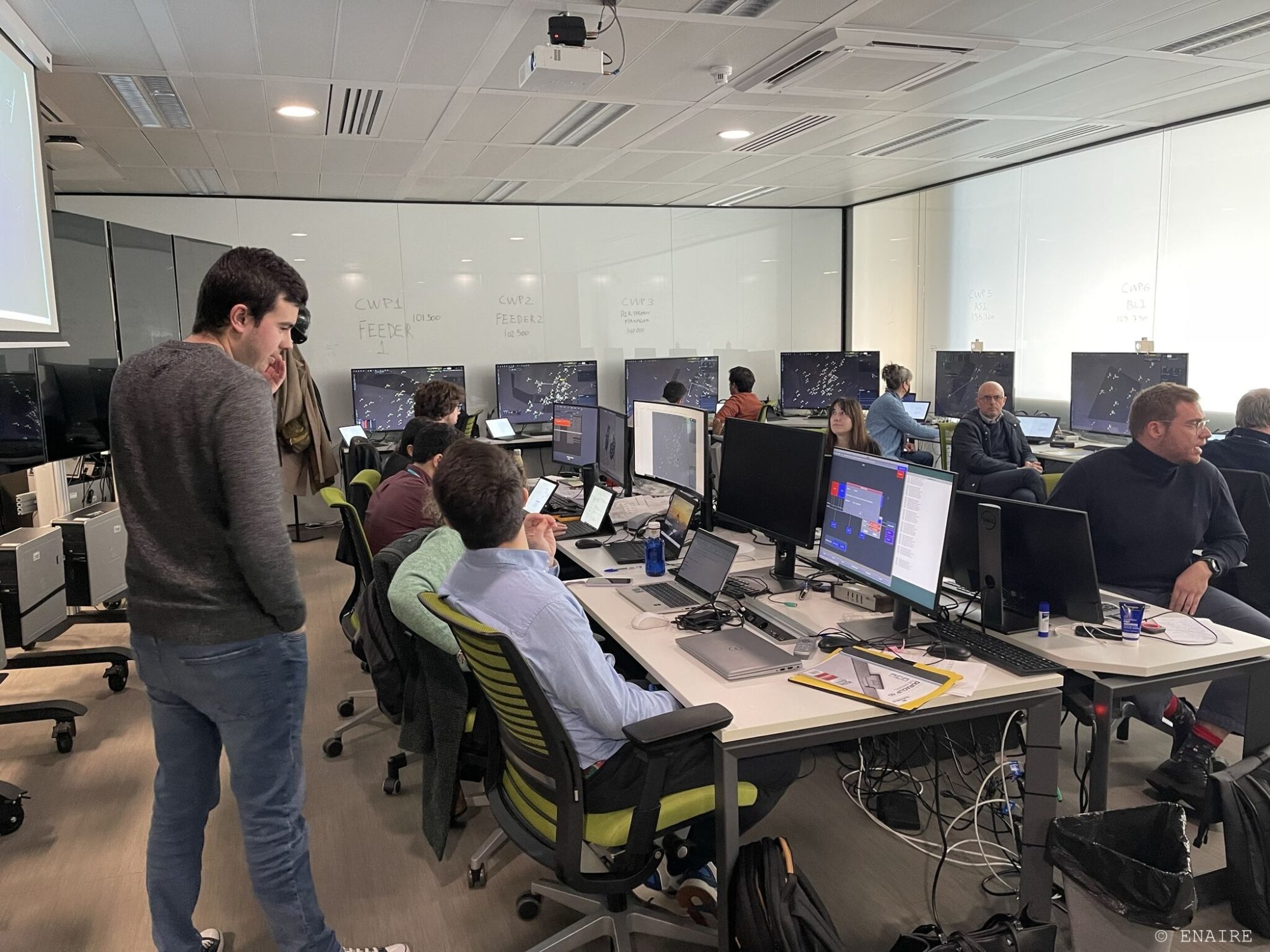
Exercise 002 is the second big milestone within the FCA project and is jointly conducted by ENAIRE/CRIDA, INECO and INDRA. The exercise assesses the operational feasibility of the FCA concept in upper airspace, building onto previous research conducted in SESAR 2020 PJ.10-W2-73 FCA by Exercise 005. Key aspects investigated by the exercise are cost efficiency, operational efficiency, capacity, environmental impact, safety and human performance. To this aim, a real-time simulation serves as the primary validation method, supported by complementary studies, including a statistical analysis to determine the optimal timing for opening and closing FCA positions based on demand and capacity balancing (DCB) simulations.
The solution scenario simulates an FCA-airspace in Madrid Route 1 with medium-complexity traffic. As the air traffic in this particular airspace is categorized as high-complexity, an airstreams structure is introduced to reduce traffic complexity. This means that a certain amount of the traffic is guided through the airspace through dedicated lanes that are regarded as segregated airspace rather than part of FCA, and controlled by airstream managers instead of FCA controllers. Flight allocation in this exercise is managed through a semi-manual strategy, ensuring balanced workload distribution. A key focus is the Allocator role, supported by a prototype of an allocation tool for monitoring and adjusting the system-suggested allocation. The exercise assesses the new and modified roles, responsibilities, and task distribution, both under nominal and non-nominal conditions. Particular emphasis is placed on the opening and closure of FCA positions, ensuring controllers can manage workload effectively. For comparison, a reference scenario will use the same traffic sample within a sector-based structure in Madrid ACC. In this setup, CD&R tools will include only basic functionalities, allowing an isolated assessment of FCA improvements.
By addressing key research gaps and refining FCA procedures, Exercise 002 will provide critical insights into the practical implementation and feasibility of Flight Centric ATC, supporting its transition towards the targeted maturity level TRL6 and future industrialization and deployment.